Showing posts with label milestone. Show all posts

31 October 2008

More Progress -- Numbers Going UP!

In addition to quantifiable and documented proof that I've had an increase in motor function, Dr. Becker's evaluation report presented evidence of a return in sensory function, as well.

Much like motor function, the ASIA exam also scores sensory function, however, on a different scale. Light touch and pin-prick (pain) sensation are graded, at each of the 28 key sensory points, as follows:

Sensory Grading Scale
0 = absent sensation
1 = impaired sensation
2 = normal sensation

The official ASIA exam form provides guidelines on where key sensory points for each level are located. It also does a nice job of delineating exactly to where the nerve roots of each vertebral level corresponds to the body.

This (right) is what I like to call the ASIAn Man. Perhaps a modern Vitruvian – only illustrating a different standard of measure. Each area on the ASIAn Man is labeled with the vertebral level that determines its sensory function – i.e., C4 is labeled as such because the nerve roots that carry nerve impulses back and forth to that area of the body insert just below the C4 vertebra.

The black dots in each area indicates its key sensory point – i.e., the spot that is tested with the sharp/light stimulus.

The response to each is graded and recorded on a chart, much like the chart used for scoring the motor function of the exam. The maximum score for each side is 56, for a total of 112 possible points. (If you have no neurological damage, you would score 112.)

There are typically two rows to the following chart - one for upper extremities (C-2 to T-8), one for lower extremities (T-9 to S4/5) - but, my second row is all zeros, and that's rather depressing, so we'll stick with the upper extremities. For now. ;)

My initial evaluation exam resulted in these scores:

Sensory exam, pin-prick 05/06/08
C2 C3 C4 C5 C6 C7 C8 T1 T2 T3 T4 T5 T6 T7 T8
R 2 2 2 0 0 0 0 0 0 0 0 0 0 0 0 6
L 2 2 2 0 0 0 0 0 0 0 0 0 0 0 0 6

That's grade 2, or "normal", sensory function down to C-4. It's fairly typical, as C-4 is my level of injury. So, that's a grand total of 12.

After just over two months in therapy, my exam score was:


Sensory exam, pin-prick 10/07/08
C2 C3 C4 C5 C6 C7 C8 T1 T2 T3 T4 T5 T6 T7 T8
R 2 2 2 0 0 0 0 0 0 0 0 0 0 0 0
L 2 2 2 0 0 0 0 1 0 0 0 0 0 0 0

Another lonely 1 in the left column, surrounded by zeros. I am, however, undaunted by what might appear to be a negligible development because the promising part is not so much in the number itself, but the colum it stands in – T-1. That is the exciting part! If there is communication down to T-1, then there is hope for all the zeros between it and C-4. And, if I'm able to recover that one connection after 17 years, then there's hope for all the zeros that come after it.

My light touch scores, which were already higher than pin prick, made a more significant jump.


Sensory exam, light touch 05/06/08
C2 C3 C4 C5 C6 C7 C8 T1 T2 T3 T4 T5 T6 T7 T8
R 2 2 2 1 0 0 0 0 0 0 0 0 0 0 0 7
L 2 2 2 1 0 0 0 0 0 1 1 0 0 0 0 9

That's a total of 16. Just as is evident in my motor function, my left side is stronger.

After two months in therapy, my sensory function scored:


Sensory exam, light touch 10/07/08
C2 C3 C4 C5 C6 C7 C8 T1 T2 T3 T4 T5 T6 T7 T8
R 2 2 2 0 0 0 0 0 1 1 0 0 0 0 0 8
L 2 2 2 1 0 0 0 1 0 2 1 0 0 0 0 11

And that is a total of 19. I'm very excited at all the numbers popping up down in the T level -- not to mention thrilled with what I'm now able to feel. For example, I can now sense hot and cold on my upper left arm, a few inches lower than I was previously able to feel. I can feel the stim on the back of my right shoulder, just below my scapular -- both the muscle contraction and the electrode being placed on my skin, neither of which I could sense in September.

If we can return, for a moment, to our ASIAn friend, you can see how my light touch scores translate over:


There are a few discrepancies between the two sets of results (e.g., there was presence of impaired sensation at right C-5 in May that did not manifest in October). Based solely on my own experience, I believe it is because sometimes, where my sensation is impaired, I have difficulty discerning between sensations. In some places,well below any levels that are scored on the ASIA exam, I can feel pressure, but no skin sensation. In other areas, I can feel something has touched me, but I don't feel the sharpness of the pin. So, it's often difficult to say, since I can't see what's going on and my sensory perception is not 100 percent.

Over all, my ASIA scores have gone from 12 and 16 to 13 and 19 on pin prick and light touch, respectively. We're heading in the right diection!

16 October 2008

Riding the RT300 FES Bike

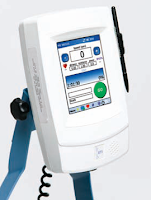
RT300 FES Leg bike -- Click to enlarge.
Tuesday (10/14/08) was an exciting day in PT. It was my first time using the FES bike with my legs.  I was only able to last about 20 minutes; the muscles in my legs have atrophied after such a long period of disuse that, even with the e-stim, they don't have enough strength to continue working long before fatigue sets in.  Cara, master of informative analogy, likens it to a marathon – without training, a runner's muscles might be able to last short distances, but can't maintain a running pace through the entirety of a marathon.  Our goal, for now, is to build up the amount of time I can sustain viable muscle contractions while using the bike. 
Using the RT300 Bike is one of the central elements of the ICSCI therapy program.  The repetitive motion of the legs pushing the pedals helps to re-establish neural pathways in the spinal cord so the electric pulse of messages can travel between the brain and the body, facilitating communication and allowing the brain to control parts of the body.
The bike is a sophisticated, multi-faceted piece of equipment created by Dr. John McDonald, PhD., M.D., based on Patrick Rummerfeild's work.   It has a built-in computer system, running Windows Mobile on what appears to be some flavor of Compaq hardware, with a Bluetooth Internet connection.   Therapists are able to program patient-specific session parameters remotely, via Web browser, or through the touch-screen interface on the bike.  
One of the really great features of this exceptional piece of equipment is that it monitors and records therapy session data such as amount of stim used, amount of energy expended, session time, distance traveled, and several other variables.  It uploads the information to a database to track user progress.  Therapists and users can log into the Web interface and generate reports that list statistics and create graphs to illustrate progress over time. 

Cara attached electrodes to my quadriceps, hamstrings, and glutes, and took the leg rests off of my chair.  I pulled up to the bike, and she and Keena set my feet on the foot plates and strapped my legs in.  They attached the electrodes on my legs to the blue wires that plug into the onboard computer. The bike itself controls the e-stim, rather than a separate Empi unit.
Cara (who is always amazingly well-prepared for everything) had already programmed in all my settings, so she just logged me in to the system and pressed the big green “Go” button on the touch screen.  
The bike started up in “passive therapy” mode, which is used as a warm-up period.  In passive mode, no stim is sent to the muscles; the mechanical device inside the bike turns the pedals, usually for a period of three to five minutes.  As the pedals began to turn and my legs began to move, I just watched.  It was almost surreal, watching my own legs pedal away, moving in a manner I hadn’t seen for half a lifetime.  
It was almost a sensory overload for me.  I’m not accustomed to that much input, and it was almost overwhelming.  For the first few minutes, it consumed my brain power – in fact, I had to excuse myself from a conversation with Cara because the sheer strangeness of the experience usurped my attention and seemed to short-circuit my thought processes and I was having difficulty following what she was saying.
I can hardly describe the sensation.  The closest I could get, at the time, was “floaty”.   Perhaps not the best word choice – words like “floaty” are often used to describe the lightheaded sensation that occurs during a rapid drop in blood pressure that often precedes loss of consciousness.  Cara, who was particularly wary of adverse effects during my initial biking session, was alarmed by my description, until I assured her I meant my legs, not my head, felt floaty.
After five minutes, “active therapy” mode started; the e-stim kicked in, causing the muscles in my legs to contract and push the pedals.  I could discern between the active and passive modes, but I’m not sure how.  How each mode felt to me, of course, is much different than it would feel to someone with unimpaired sensation, so there was not as drastic a difference between them for me, thus making it difficult to pinpoint what had changed.  I will work on isolating the difference and describing it to myself during my next biking session, so I can more accurately convey the experience in future posts.
Though I was able to last only 20 minutes during my Tuesday session, Cara tweaked some parameters and I went for 30 minutes on Wednesday.  We’re working up to doing an hour at a time.  Cara said that an hour using the bike is equivalent to 5,000 steps, which is about half the number walked daily by the average person.

08 October 2008

Prelude to a Re-eval

Originally, I'd intended to post the third and final part of the subluxation series today, however, your normally-scheduled reading is being preempted with some breaking news. (I'll resume the subluxation discussion this weekend with some really neat stuff about FES.)


Monday night (10/06/08), when Rich touched my arm, I gasped, and looked up at him, startled.

He snatched his hands back. "What? What's wrong?"

It wasn't any different than the way he usually does it – fingers lightly brushing against my shoulder and upper arm. The muted pressure under the surface of my skin was just as it always was when his fingers reached the middle of my upper arm, but accompanying that pressure was something new. What was different this time, I told him, "That tickled!"

A grin lit up his face, and he repeated the motion. "That?"

"Yes!" I said, probably looking more bewildered than vellicated by the touch, taking in the sensation as if for the first time. It had been so long since I'd felt anything but the vague echo of presence in that area of my arm that I'd forgotten anything was ever there; the sensation was almost unrecognizable. Bright ribbons of current followed his fingers across my skin and dissolved into white hot sparks that shot through the murky ether of my forearm and hand.

And, there it was – vibrant, unmistakable, alive. Sensation.

I can now feel an area in my left, upper arm that I have not been able to feel in 17 years.

"Big deal," you may say – and it may not sound like much, because it doesn't do much for me functionally – but, I assure you, it is big. It is huge. Beyond the augmented sensory perception – which, in itself, is very cool – the significance of this regained sensory function lies in what it indicates: that after 17 years, it can be recovered.

The experience I've just recounted; the experience, in this very moment, of my sleeve rubbing against my arm as I type these words – impossible, according to conventional thought on SCI. Sensory perception at that particular point of the arm is at level T-3. After 17 years at level C-4, I should not be able to feel that.

But, I do.

Tomorrow: re-eval and documented proof.