
Tomorrow, I will begin therapy again. This time, however, the course of therapy is not physical therapy, or even occupational therapy. Tomorrow, I will begin speech therapy.
"Wait, what?" you must say to yourself. "Speech therapy? Uh... couldn't you already speak, Vic? Didn't you learn that 35 years ago?"
Indeed, I did — until I had a stroke. Now, I have to re-learn to speak... and write.
Early on the morning of January 30, 2010, I began hallucinating. It was about an hour after I'd taken my customary fistful of pills before bed, and was waiting to fall asleep, when I noticed the mental images were not fleeting, but vivid. I was not drifting to sleep behind my eyelids, I was watching a movie — framed with blue noodles.
I told Rich what I was seeing, but when my eyes were open, everything seemed fine. A while later, when I was asking Gladys, my aide, to help reposition me, she could not understand what I was saying.
My words failed me. Every sound I uttered was unfamiliar — nothing coming out of my mouth was at all what I meant to say. Confused, then disconcerted, then frantic — the single intelligible syllable I managed amidst the mangled words: "Rich!!"
... and another chapter in my life unfolds.
Showing posts with label therapy. Show all posts
Showing posts with label therapy. Show all posts
21 March 2010
31 October 2008
More Progress -- Numbers Going UP!
Labels:
ASIA Impairment Scale,
C-4,
cervical spine,
e-stim,
ICSCI,
level,
milestone,
nerve roots,
re-eval,
recover,
sensation,
sensory function,
therapy
In addition to quantifiable and documented proof that I've had an increase in motor function, Dr. Becker's evaluation report presented evidence of a return in sensory function, as well.
Much like motor function, the ASIA exam also scores sensory function, however, on a different scale. Light touch and pin-prick (pain) sensation are graded, at each of the 28 key sensory points, as follows:
Sensory Grading Scale
0 = absent sensation
1 = impaired sensation
2 = normal sensation
The official ASIA exam form provides guidelines on where key sensory points for each level are located. It also does a nice job of delineating exactly to where the nerve roots of each vertebral level corresponds to the body.
 This (right) is what I like to call the ASIAn Man. Perhaps a modern Vitruvian – only illustrating a different standard of measure. Each area on the ASIAn Man is labeled with the vertebral level that determines its sensory function – i.e., C4 is labeled as such because the nerve roots that carry nerve impulses back and forth to that area of the body insert just below the C4 vertebra.
The black dots in each area indicates its key sensory point – i.e., the spot that is tested with the sharp/light stimulus.
The response to each is graded and recorded on a chart, much like the chart used for scoring the motor function of the exam. The maximum score for each side is 56, for a total of 112 possible points. (If you have no neurological damage, you would score 112.)
There are typically two rows to the following chart - one for upper extremities (C-2 to T-8), one for lower extremities (T-9 to S4/5) - but, my second row is all zeros, and that's rather depressing, so we'll stick with the upper extremities. For now. ;)
My initial evaluation exam resulted in these scores:
That's grade 2, or "normal", sensory function down to C-4. It's fairly typical, as C-4 is my level of injury. So, that's a grand total of 12.
After just over two months in therapy, my exam score was:
Another lonely 1 in the left column, surrounded by zeros. I am, however, undaunted by what might appear to be a negligible development because the promising part is not so much in the number itself, but the colum it stands in – T-1. That is the exciting part! If there is communication down to T-1, then there is hope for all the zeros between it and C-4. And, if I'm able to recover that one connection after 17 years, then there's hope for all the zeros that come after it.
My light touch scores, which were already higher than pin prick, made a more significant jump.
That's a total of 16. Just as is evident in my motor function, my left side is stronger.
After two months in therapy, my sensory function scored:
And that is a total of 19. I'm very excited at all the numbers popping up down in the T level -- not to mention thrilled with what I'm now able to feel. For example, I can now sense hot and cold on my upper left arm, a few inches lower than I was previously able to feel. I can feel the stim on the back of my right shoulder, just below my scapular -- both the muscle contraction and the electrode being placed on my skin, neither of which I could sense in September.
If we can return, for a moment, to our ASIAn friend, you can see how my light touch scores translate over:

There are a few discrepancies between the two sets of results (e.g., there was presence of impaired sensation at right C-5 in May that did not manifest in October). Based solely on my own experience, I believe it is because sometimes, where my sensation is impaired, I have difficulty discerning between sensations. In some places,well below any levels that are scored on the ASIA exam, I can feel pressure, but no skin sensation. In other areas, I can feel something has touched me, but I don't feel the sharpness of the pin. So, it's often difficult to say, since I can't see what's going on and my sensory perception is not 100 percent.
Over all, my ASIA scores have gone from 12 and 16 to 13 and 19 on pin prick and light touch, respectively. We're heading in the right diection!
 In addition to quantifiable and documented proof that I've had an increase in motor function, Dr. Becker's evaluation report presented evidence of a return in sensory function, as well.
Much like motor function, the ASIA exam also scores sensory function, however, on a different scale. Light touch and pin-prick (pain) sensation are graded, at each of the 28 key sensory points, as follows:
Sensory Grading Scale
0 = absent sensation
1 = impaired sensation
2 = normal sensation
The official ASIA exam form provides guidelines on where key sensory points for each level are located. It also does a nice job of delineating exactly to where the nerve roots of each vertebral level corresponds to the body.

The black dots in each area indicates its key sensory point – i.e., the spot that is tested with the sharp/light stimulus.
The response to each is graded and recorded on a chart, much like the chart used for scoring the motor function of the exam. The maximum score for each side is 56, for a total of 112 possible points. (If you have no neurological damage, you would score 112.)
There are typically two rows to the following chart - one for upper extremities (C-2 to T-8), one for lower extremities (T-9 to S4/5) - but, my second row is all zeros, and that's rather depressing, so we'll stick with the upper extremities. For now. ;)
My initial evaluation exam resulted in these scores:
| Sensory exam, pin-prick | 05/06/08 |
| C2 | C3 | C4 | C5 | C6 | C7 | C8 | T1 | T2 | T3 | T4 | T5 | T6 | T7 | T8 | ||
| R | 2 | 2 | 2 | 0 | 0 | 0 | 0 | 0 | 0 | 0 | 0 | 0 | 0 | 0 | 0 | 6 |
| L | 2 | 2 | 2 | 0 | 0 | 0 | 0 | 0 | 0 | 0 | 0 | 0 | 0 | 0 | 0 | 6 |
That's grade 2, or "normal", sensory function down to C-4. It's fairly typical, as C-4 is my level of injury. So, that's a grand total of 12.
After just over two months in therapy, my exam score was:
| Sensory exam, pin-prick | 10/07/08 |
| C2 | C3 | C4 | C5 | C6 | C7 | C8 | T1 | T2 | T3 | T4 | T5 | T6 | T7 | T8 | |
| R | 2 | 2 | 2 | 0 | 0 | 0 | 0 | 0 | 0 | 0 | 0 | 0 | 0 | 0 | 0 |
| L | 2 | 2 | 2 | 0 | 0 | 0 | 0 | 1 | 0 | 0 | 0 | 0 | 0 | 0 | 0 |
Another lonely 1 in the left column, surrounded by zeros. I am, however, undaunted by what might appear to be a negligible development because the promising part is not so much in the number itself, but the colum it stands in – T-1. That is the exciting part! If there is communication down to T-1, then there is hope for all the zeros between it and C-4. And, if I'm able to recover that one connection after 17 years, then there's hope for all the zeros that come after it.
My light touch scores, which were already higher than pin prick, made a more significant jump.
| Sensory exam, light touch | 05/06/08 |
| C2 | C3 | C4 | C5 | C6 | C7 | C8 | T1 | T2 | T3 | T4 | T5 | T6 | T7 | T8 | ||
| R | 2 | 2 | 2 | 1 | 0 | 0 | 0 | 0 | 0 | 0 | 0 | 0 | 0 | 0 | 0 | 7 |
| L | 2 | 2 | 2 | 1 | 0 | 0 | 0 | 0 | 0 | 1 | 1 | 0 | 0 | 0 | 0 | 9 |
That's a total of 16. Just as is evident in my motor function, my left side is stronger.
After two months in therapy, my sensory function scored:
| Sensory exam, light touch | 10/07/08 |
| C2 | C3 | C4 | C5 | C6 | C7 | C8 | T1 | T2 | T3 | T4 | T5 | T6 | T7 | T8 | ||
| R | 2 | 2 | 2 | 0 | 0 | 0 | 0 | 0 | 1 | 1 | 0 | 0 | 0 | 0 | 0 | 8 |
| L | 2 | 2 | 2 | 1 | 0 | 0 | 0 | 1 | 0 | 2 | 1 | 0 | 0 | 0 | 0 | 11 |
And that is a total of 19. I'm very excited at all the numbers popping up down in the T level -- not to mention thrilled with what I'm now able to feel. For example, I can now sense hot and cold on my upper left arm, a few inches lower than I was previously able to feel. I can feel the stim on the back of my right shoulder, just below my scapular -- both the muscle contraction and the electrode being placed on my skin, neither of which I could sense in September.
If we can return, for a moment, to our ASIAn friend, you can see how my light touch scores translate over:

There are a few discrepancies between the two sets of results (e.g., there was presence of impaired sensation at right C-5 in May that did not manifest in October). Based solely on my own experience, I believe it is because sometimes, where my sensation is impaired, I have difficulty discerning between sensations. In some places,well below any levels that are scored on the ASIA exam, I can feel pressure, but no skin sensation. In other areas, I can feel something has touched me, but I don't feel the sharpness of the pin. So, it's often difficult to say, since I can't see what's going on and my sensory perception is not 100 percent.
Over all, my ASIA scores have gone from 12 and 16 to 13 and 19 on pin prick and light touch, respectively. We're heading in the right diection!


29 October 2008
Survey Says... Progress!
Labels:
ASIA Impairment Scale,
C-4,
cervical spine,
ICSCI,
motor function,
Muscle Grading Scale,
OT,
PT,
re-eval,
therapy
OT and PT re-evaluations are done every 30 days. The therapists write an evaluation report for each, to document any changes, record progress made toward therapy goals, and re-establish new goals accordingly. A progress report, of sorts. One of the (many) things I like about the ICSCI is that they mail a copy of each evaluation report to me, so I can easily refer back to the information. (Although, the first couple of correspondences from them were, amusingly enough, addressed to the "Parent or Guardian of Victoria Popdan". Common practice for a children's hospital, I guess.)
Dr. Becker sends me a copy of his evaluation reports, as well. Though I knew I'd made significant progress from what Dr. Becker told me at the end of the evaluation, it's quite another thing to see it on paper. I now have documented evidence that there has been improvement in my sensory/motor function. I can barely wrap my head around it. Even looking at the paper in front of me, I can hardly believe it. But, it's true!
As I mentioned in a previous post, the ASIA exam done during an SCI evaluation quantifies motor function in 10 key muscles – five upper-extremity, and five lower-extremity, on each side – and each of the 10 muscles is graded on a scale from 0-5, with 0 indicating no function and 5 indicating full (normal) function. Maximum score is 100 (50 for bilateral upper extremities, 50 for lower).
The result of my initial evaluation indicates a total motor function score of 5.

After just two months in therapy at the ICSCI, my motor function has increased to 7.
Two points may not seem like much to write home about but, I assure you, it is HUGE. That 1 in the right column might look awfully lonely, standing in that column all by itself, but it is indicative of something I never thought I'd live to see – function in my right arm. That solitary number is not lonely, it is defiant – and it has invited some friends.
Although my right trace triceps is not accounted for here, it is present, and I've been working to strengthen it. It is, however, currently very weak, and sometimes difficult to detect. I suspect it could be that my positioning (supine) during the re-eval exam was different than my positioning (sitting upright) during OT when Mike first found it.
It can also be very difficult to attempt to use a particular muscle because I forget how. I forget how the movement goes. Often times when I try to move something, the other, functioning muscles around it tend to interfere - I'm so accustomed to using them to compensate for the deficit that it's the only way I know how to move, and I can't not use them. This can also make it difficult to detect what is moving.
Dr. Becker sends me a copy of his evaluation reports, as well. Though I knew I'd made significant progress from what Dr. Becker told me at the end of the evaluation, it's quite another thing to see it on paper. I now have documented evidence that there has been improvement in my sensory/motor function. I can barely wrap my head around it. Even looking at the paper in front of me, I can hardly believe it. But, it's true!
As I mentioned in a previous post, the ASIA exam done during an SCI evaluation quantifies motor function in 10 key muscles – five upper-extremity, and five lower-extremity, on each side – and each of the 10 muscles is graded on a scale from 0-5, with 0 indicating no function and 5 indicating full (normal) function. Maximum score is 100 (50 for bilateral upper extremities, 50 for lower).
The result of my initial evaluation indicates a total motor function score of 5.
After just two months in therapy at the ICSCI, my motor function has increased to 7.
Two points may not seem like much to write home about but, I assure you, it is HUGE. That 1 in the right column might look awfully lonely, standing in that column all by itself, but it is indicative of something I never thought I'd live to see – function in my right arm. That solitary number is not lonely, it is defiant – and it has invited some friends.
Although my right trace triceps is not accounted for here, it is present, and I've been working to strengthen it. It is, however, currently very weak, and sometimes difficult to detect. I suspect it could be that my positioning (supine) during the re-eval exam was different than my positioning (sitting upright) during OT when Mike first found it.
It can also be very difficult to attempt to use a particular muscle because I forget how. I forget how the movement goes. Often times when I try to move something, the other, functioning muscles around it tend to interfere - I'm so accustomed to using them to compensate for the deficit that it's the only way I know how to move, and I can't not use them. This can also make it difficult to detect what is moving.
In all – motor function already improving; from 5 to 7 on ASIA scale.
Tomorrow, I'm back with more good news from the sensory function front.
25 October 2008
More from ASIA - Measuring Motor Function
Labels:
ASIA Impairment Scale,
e-stim,
ICSCI,
motor function,
Muscle Grading Scale,
re-eval,
recover,
sensory function,
therapy
The third part of the ASIA exam tests motor function. It determines the presence, and quantifies the functionality, of 10 key muscles – five upper–extremity, and five lower–extremity, on each side – each of which indicates a specific level of ability.
Each of the 10 muscles are tested just as you'd imagine – the doctor or therapist administering the exam asks the patient to move the specific muscle, e.g., "lift your finger up toward the ceiling" or "point your big toe down toward the floor", and such.
From the doctor's or therapist's end, this part can get a little tricky because there are different degrees of muscle function and people who have spinal cord injuries can often flex or contract a muscle without having full use of it, so the doctor or therapist has to feel for muscle movement. As a standard method of quantifying motor function, they use the six–point Motor Grading Scale.
From my end, much like the sensory part, this part of the exam gets a little frustrating. Although I am well aware of the intent behind their asking, being repeatedly urged to move things we both know I can't move is often exasperating. I always give it the old college try when prompted, but nothing ever happens when I'm asked to, say, bend my knee. They always stand there, expectantly, hands on my leg and focusing intently, and I try to move, and nothing happens, and I can't help but feel as if I've failed them somehow. Perhaps my being able to effectively perform only one of the 10 movements (elbow flexion) listed above contributes to that sentiment. I debate diagnostic measures in my head but, for some reason, no amount of rationalizing seems to quash that lingering sense of failure to perform. Logic be damned, some things you just can't argue yourself out of.
This particular point of contention I've long had with the AISA exam is somewhat alleviated, and also somewhat amplified, by the circumstances of my therapy at the ICSCI. It's less vexing when I'm asked to move because I know they're trying to assess and track my progress in therapy (rather than, as it has often seemed to me in the past, satisfy some idle curiosity), but it also heightens that sense of failure because I feel like I should be accomplishing more – as if I should be making faster, better progress in therapy, and my performance during the ASIA exam should reflect that improvement.
Though I never actually expect to move, I still manage to be disappointed when I don't; I can't help but feel that whomever is administering the exam is disappointed, as well. It's rather silly, really. It's not as if I could study for the exam. But, again, no amount of rationalization seems to allay my inner critics. (I have my own personal peanut gallery, but that is a story for another day.)
What I find more exasperating than any other aspect of the ASIA exam is when I feel the muscle move but they don't. I know it's there; I can feel it, I can flex it, I can intentionally, purposefully cause it to contract. Or can I? While I realize that the movement is weak and thus difficult to detect, I'm sure it's there. I'm sure I'm moving it. I'm sure, that is, until the doctor or therapist is unable to detect it.
That particular frustration is typically fleeting, because I know that if I can feel it – even if they can't – there is a connection. Something is getting through. A nerve impulse is making the trip, unmarred and uninterrupted, from my brain to the muscle – that means there is the distinct possibility for improvement.
I know this from experience. I can remember sitting in the OT/PT gym at NRH, not long after I was injured, telling the therapist that there was something in my left arm – that I could flex my biceps. She tested and retested, but felt nothing. It was three years before I was able to lift my hand up to my face; two more years passed before my biceps was strong enough to reliably drive my chair. Who knows if it would've come back at all, if I hadn't been so stubborn and kept trying to move my arm until it did. Who knows how much faster it would've returned if I'd had the kind of therapy practiced at the ICSCI.
| Key Muscles | |
|---|---|
| elbow flexion (C-5) | hip flexion (L-2) |
| wrist extension (C-6) | knee extension (L-3) |
| elbow extension (C-7) | ankle dorsiflexion (L-4) |
| finger flexion (C-8) | toe extension (L-5) |
| finger abduction (T-1) | ankle plantar flexion (S-1) |
Each of the 10 muscles are tested just as you'd imagine – the doctor or therapist administering the exam asks the patient to move the specific muscle, e.g., "lift your finger up toward the ceiling" or "point your big toe down toward the floor", and such.
From the doctor's or therapist's end, this part can get a little tricky because there are different degrees of muscle function and people who have spinal cord injuries can often flex or contract a muscle without having full use of it, so the doctor or therapist has to feel for muscle movement. As a standard method of quantifying motor function, they use the six–point Motor Grading Scale.
| Motor Grading Scale |
|---|
| 0 = no active movement |
| 1 = muscle contraction (also called "trace" or "muscle trace" |
| 2 = movement through range of motion (ROM) without gravity |
| 3 = movement through ROM against gravity |
| 4 = movement against some resistance |
| 5 = movement against full resistance |
From my end, much like the sensory part, this part of the exam gets a little frustrating. Although I am well aware of the intent behind their asking, being repeatedly urged to move things we both know I can't move is often exasperating. I always give it the old college try when prompted, but nothing ever happens when I'm asked to, say, bend my knee. They always stand there, expectantly, hands on my leg and focusing intently, and I try to move, and nothing happens, and I can't help but feel as if I've failed them somehow. Perhaps my being able to effectively perform only one of the 10 movements (elbow flexion) listed above contributes to that sentiment. I debate diagnostic measures in my head but, for some reason, no amount of rationalizing seems to quash that lingering sense of failure to perform. Logic be damned, some things you just can't argue yourself out of.
This particular point of contention I've long had with the AISA exam is somewhat alleviated, and also somewhat amplified, by the circumstances of my therapy at the ICSCI. It's less vexing when I'm asked to move because I know they're trying to assess and track my progress in therapy (rather than, as it has often seemed to me in the past, satisfy some idle curiosity), but it also heightens that sense of failure because I feel like I should be accomplishing more – as if I should be making faster, better progress in therapy, and my performance during the ASIA exam should reflect that improvement.
Though I never actually expect to move, I still manage to be disappointed when I don't; I can't help but feel that whomever is administering the exam is disappointed, as well. It's rather silly, really. It's not as if I could study for the exam. But, again, no amount of rationalization seems to allay my inner critics. (I have my own personal peanut gallery, but that is a story for another day.)
What I find more exasperating than any other aspect of the ASIA exam is when I feel the muscle move but they don't. I know it's there; I can feel it, I can flex it, I can intentionally, purposefully cause it to contract. Or can I? While I realize that the movement is weak and thus difficult to detect, I'm sure it's there. I'm sure I'm moving it. I'm sure, that is, until the doctor or therapist is unable to detect it.
That particular frustration is typically fleeting, because I know that if I can feel it – even if they can't – there is a connection. Something is getting through. A nerve impulse is making the trip, unmarred and uninterrupted, from my brain to the muscle – that means there is the distinct possibility for improvement.
I know this from experience. I can remember sitting in the OT/PT gym at NRH, not long after I was injured, telling the therapist that there was something in my left arm – that I could flex my biceps. She tested and retested, but felt nothing. It was three years before I was able to lift my hand up to my face; two more years passed before my biceps was strong enough to reliably drive my chair. Who knows if it would've come back at all, if I hadn't been so stubborn and kept trying to move my arm until it did. Who knows how much faster it would've returned if I'd had the kind of therapy practiced at the ICSCI.
16 October 2008
Riding the RT300 FES Bike

Tuesday (10/14/08) was an exciting day in PT. It was my first time using the FES bike with my legs. I was only able to last about 20 minutes; the muscles in my legs have atrophied after such a long period of disuse that, even with the e-stim, they don't have enough strength to continue working long before fatigue sets in. Cara, master of informative analogy, likens it to a marathon – without training, a runner's muscles might be able to last short distances, but can't maintain a running pace through the entirety of a marathon. Our goal, for now, is to build up the amount of time I can sustain viable muscle contractions while using the bike.
Using the RT300 Bike is one of the central elements of the ICSCI therapy program. The repetitive motion of the legs pushing the pedals helps to re-establish neural pathways in the spinal cord so the electric pulse of messages can travel between the brain and the body, facilitating communication and allowing the brain to control parts of the body.
The bike is a sophisticated, multi-faceted piece of equipment created by Dr. John McDonald, PhD., M.D., based on Patrick Rummerfeild's work. It has a built-in computer system, running Windows Mobile on what appears to be some flavor of Compaq hardware, with a Bluetooth Internet connection. Therapists are able to program patient-specific session parameters remotely, via Web browser, or through the touch-screen interface on the bike.
One of the really great features of this exceptional piece of equipment is that it monitors and records therapy session data such as amount of stim used, amount of energy expended, session time, distance traveled, and several other variables. It uploads the information to a database to track user progress. Therapists and users can log into the Web interface and generate reports that list statistics and create graphs to illustrate progress over time.
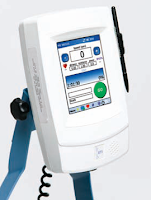
Cara attached electrodes to my quadriceps, hamstrings, and glutes, and took the leg rests off of my chair. I pulled up to the bike, and she and Keena set my feet on the foot plates and strapped my legs in. They attached the electrodes on my legs to the blue wires that plug into the onboard computer. The bike itself controls the e-stim, rather than a separate Empi unit.
Cara (who is always amazingly well-prepared for everything) had already programmed in all my settings, so she just logged me in to the system and pressed the big green “Go” button on the touch screen.
The bike started up in “passive therapy” mode, which is used as a warm-up period. In passive mode, no stim is sent to the muscles; the mechanical device inside the bike turns the pedals, usually for a period of three to five minutes. As the pedals began to turn and my legs began to move, I just watched. It was almost surreal, watching my own legs pedal away, moving in a manner I hadn’t seen for half a lifetime.
It was almost a sensory overload for me. I’m not accustomed to that much input, and it was almost overwhelming. For the first few minutes, it consumed my brain power – in fact, I had to excuse myself from a conversation with Cara because the sheer strangeness of the experience usurped my attention and seemed to short-circuit my thought processes and I was having difficulty following what she was saying.
I can hardly describe the sensation. The closest I could get, at the time, was “floaty”. Perhaps not the best word choice – words like “floaty” are often used to describe the lightheaded sensation that occurs during a rapid drop in blood pressure that often precedes loss of consciousness. Cara, who was particularly wary of adverse effects during my initial biking session, was alarmed by my description, until I assured her I meant my legs, not my head, felt floaty.
After five minutes, “active therapy” mode started; the e-stim kicked in, causing the muscles in my legs to contract and push the pedals. I could discern between the active and passive modes, but I’m not sure how. How each mode felt to me, of course, is much different than it would feel to someone with unimpaired sensation, so there was not as drastic a difference between them for me, thus making it difficult to pinpoint what had changed. I will work on isolating the difference and describing it to myself during my next biking session, so I can more accurately convey the experience in future posts.
Though I was able to last only 20 minutes during my Tuesday session, Cara tweaked some parameters and I went for 30 minutes on Wednesday. We’re working up to doing an hour at a time. Cara said that an hour using the bike is equivalent to 5,000 steps, which is about half the number walked daily by the average person.
19 September 2008
Without a Net
Labels:
assistant,
therapy,
transfering
I've hired a new assistant, Sonia. So far, she's really great -- picks up on things quickly, understands what the therapists are teaching her, and doesn't make me fear for my life each time I get into the van. We made it to therapy all three days this week.
I realized something on Tuesday, as Cara was transferring me from my chair to the standing frame and Sonia watched with a rather concerned look on her face. Hanging from the ceiling in the Goldman lift*, watching the floor pass by several inches below my dangling feet, I suddenly realized that this was the first time I'd ever been out of my chair without a safety net. By safety net I mean someone with whom I felt secure, someone who could get me back into my chair unharmed and straighten me out so I'm sitting properly.
Getting me situated in my chair is much more difficult than you might think, particularly with the deplorably scoliotic state of my back. We need to make sure my hips are even (not sitting too far to one side or the other), and that I'm pushed all the way back in the seat. Then, we need to align my trunk, which involves a shifting around of ribcage, realignment of spine, rotation of shoulders. It looks terribly uncomfortable, but it really isn't. Cathy has this process down to a science, and Rich has elevated it to an art form.
Though Cathy and Rich are both very adept at correcting my posture, they are about the only people who are. It’s not something I can easily direct someone how to do; it’s more one of those things that needs to be demonstrated. This being the case, I don’t go anywhere that I need to get out of my chair without one of them in tow. Consequently, I don’t get out of my chair during the day, which is why it was hard for me to get used to doing so when I started therapy.
So, hanging from the ceiling, watching the floor pass beneath my dangling feet, I suddenly realized that I was out of the safety of my chair, and had no foreseeable means of getting back in and situated properly, and nearly had a panic attack. I was on my own – a concept which, to me, is utterly terrifying.
Although this therapy program is intended to reawaken dormant connections in my body, it has done much the same for my mind. Being put into a variety of situations that I have not been in (whether due to lack of opportunity, or my intentionally avoiding them) for quite some time has forced me to confront fears, change perspectives, and shed the complacency I’ve built up. Sometimes, it’s more difficult to contend with than the physical aspect. But, I believe it is part of the healing.
29 July 2008
Today was my first day of therapy at the Kennedy Krieger Institute. I was only slightly anxious before going into the gym -- it's been quite a long time since I've been in one, and I had no idea what to expect -- but I know it would've felt a lot worse if Rich hadn't been there. I was so glad he went -- all the trepidation and uncertainty had vanished, and I knew I was safe because he was there.
My new PT, Cara, is but a wisp of a woman -- a mere 5' tall -- and I immediately wondered how she would handle moving me, but she did very well.
My new PT, Cara, is but a wisp of a woman -- a mere 5' tall -- and I immediately wondered how she would handle moving me, but she did very well.
Subscribe to:
Posts (Atom)

 Posts
Posts


